
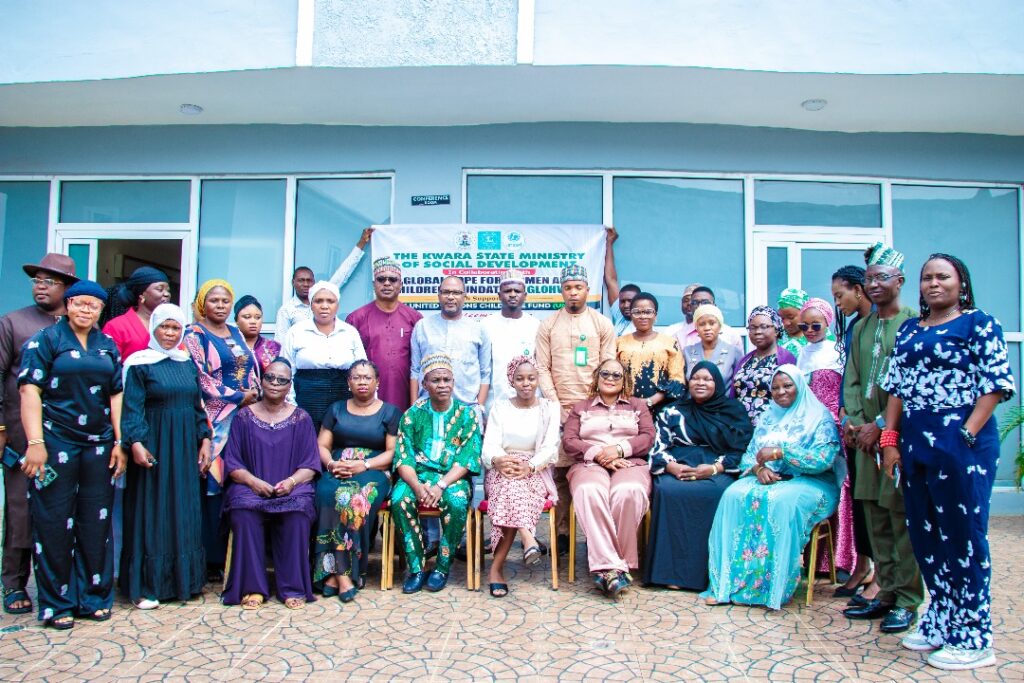
To create a long-term framework on the fight against Female Genital Mutilation (FGM) and Gender-Based Violence (GBV) in the society, the Kwara State Government, in collaboration with Global Hope for Women and Children Foundation (GLOHWOC), has trained frontline responders to support the victims’ immediate needs, defining a strategy to achieve the goals.
The training, also supported by the United Nations Children’s Fund (UNICEF), was targeted at the Civil Society Organisations (CSOs), healthcare workers, security agents and the judiciary to broaden their horizons on the practices of FGM and GBV, management of cases and to strengthen their capacity to bring the practices to an end.
Declaring the training open at Sinclair Hotel in Ilorin on Monday, the Commissioner for Social Development, Hajia Mariam Nnafatima Imam, PhD, disclosed that the training was to establish a stronger tie with GLOHWOC to end harmful traditions like FGM and GBV that are still practised in the society.
The Commissioner said the training would avail the participants the opportunity to share knowledge and build evidence on effective strategies to address female circumcision and any form of violence against people, irrespective of the gender involved.
Hajia Imam described FGM and violence against people as injurious practices that can cause a lifelong physical and psychological damage to the victims, promising to provide necessary support to the survivors as well as end the practices in the areas where they are still being practised in the society.
“We are here not only to strengthen our individual and institutional capacities but also to forge stronger partnerships that will accelerate our collective fight against all forms of violence and harmful traditional practices,” she said.
According to her, “FGM remains a grave violation of human rights, one that causes a lifelong physical, emotional and psychological harm to survivors. It has no place in our communities, our culture or our future. As a state, we are determined to work in line with national and international frameworks, including the Violence Against Persons Prohibition (VAPP) Law and the Child Rights Law, to ensure that such practices are eradicated.”
“Equally, Gender-Based Violence in all its forms, whether domestic abuse, sexual violence, economic deprivation or emotional abuse must be met with a survivor-centred response. This means listening to survivors with empathy, protecting them from further harm and ensuring they have access to justice, healthcare, psychosocial support and safe spaces,” the Commissioner added.
Hajia Imam revealed that bringing all the stakeholders together for the training was a deliberate action of the government and the implementing partner to ease the fight against female circumcision and violence against any gender, particularly commending the UNICEF for its untiring support and the GLOHWOC for its continued advocacy against FGM and GBV as well as its contributions to case management measures.
Speaking, the Chief Executive Officer, Global Hope for Women and Children Foundation, Mrs. Christiana Abayomi-Oluwole, who was the resource person at the training, disclosed that the training was organised to device a new strategy to eradicate the practices of female circumcision and gender-based violence.
Mrs. Abayomi-Oluwole disclosed that the frontline responders will be adequately trained to support the FGM and GBV survivors to recognise and properly manage complications related to their cases, while also taking actions to bring to book the perpetrators of such practices.
She explained that the training reflects the GLOHWOC’s commitment to building a sane and gender-conscious society where harmful practices such as FGM and GBV are strongly condemned and the health of female children is prioritised.
The Chief Executive Officer described female genital mutilation as a damaging practice rooted in the abuse of power and cultural norms highly detrimental to the health of the survivors with devastating effects on their personal lives, classifying female genital mutilation as clitoridectomy, excision, infibulation, piercing, pricking and burning.
Mrs. Abayomi-Oluwole, said all the types of female circumcision are cruel and none is worth putting the survivors through a lifetime of pain and enjoined the participants to be diligent in their duties during case management, urging them to prioritise the interests of the victims.